|
May 9, 2026 American police leaders discuss the threat of malicious drones
PERF members, On Thursday, PERF gathered more than 100 law enforcement professionals to discuss the threat posed by malicious drones. In 2019, we held a similar meeting that led to one of our most important publications, Drones: A Report on the Use of Drones by Public Safety Agencies—and a Wake-Up Call about the Threat of Malicious Drone Attacks. John Miller, then the NYPD Deputy Commissioner for Intelligence and Counterterrorism, said at the 2019 meeting that, “What really keeps me up at night is the fact that drones are extraordinarily simple pieces of technology for the bad guys to use. But stopping drones is an extremely complicated issue for law enforcement to navigate. We have to operate under all the rules, but they don’t have any rules slowing them down.” Seven years later, the threat has grown. With the upcoming FIFA World Cup as a possible target and the war in Iran as possible motivation for both state and nonstate actors, I believe we face an unprecedented threat of malicious drone attacks. Drones have completely changed the battlefield in Ukraine and elsewhere, and I think it’s only a matter of time before we see an attack in the United States. At this week’s meeting, we wanted to learn more about how the threat has evolved over the past seven years and whether state and local law enforcement agencies now have a greater ability to address the problem.
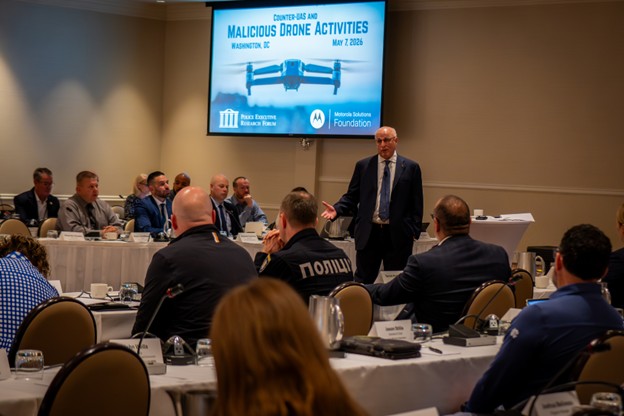
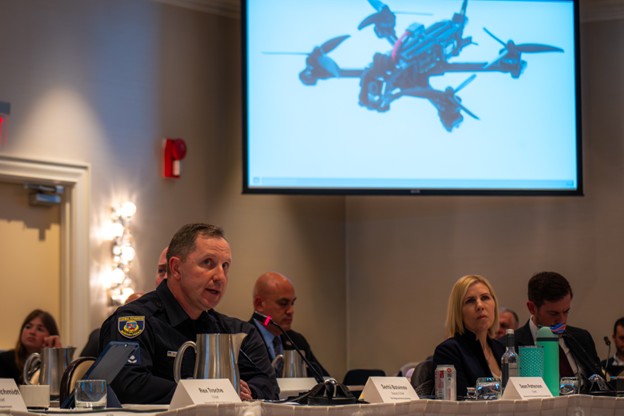
Local, state, federal, and foreign police leaders gathered in Washington, D.C., to discuss mitigating malicious drone threats. We started with a sobering presentation from officials with the FBI National Joint Terrorism Task Force about the scope of the threat posed by unmanned aircraft systems (UAS). They described what federal officials know about the current threat against critical infrastructure, including military installations, prisons, and stadiums.
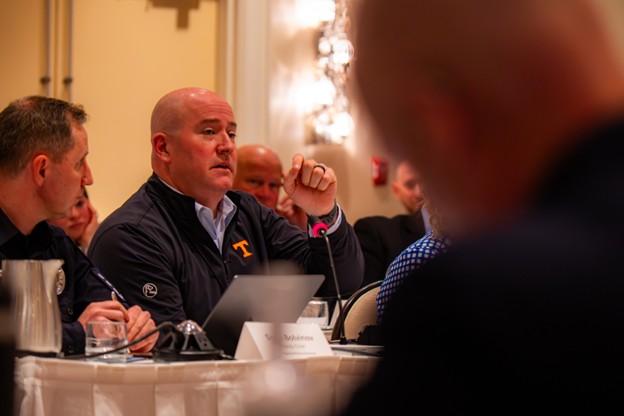
NFL Senior Vice President of Security Cathy Lanier. Meeting attendees added their own data about the scope of the threat. NFL Senior Vice President of Security Cathy Lanier said the league records more than 2,800 drone violations over their football games every year. NYPD Deputy Chief Jason Huerta told participants that New York City had approximately 23,000 illicit drone flights per month last June and July. And University of Tennessee Police Chief Sean Patterson said there were thousands of drone incursions over his campus last year. “My stadium has [a capacity of] 101,915, and another 20 or 30,000 are outside and never go inside [on a football game day],” Chief Patterson said. “In my league, some universities don’t even have metal detection, so they don’t even do personal screening when people come into the stadium. So I am kind of screaming from the hills to say that this is coming and it’s a matter of time.”
University of Tennessee Police Chief Sean Patterson. Local police officials feel like they’re struggling to catch up to the threat. “I think we are all behind the curve here,” Austin, Texas, Police Chief Lisa Davis said. “We need to be running toward solutions, not walking. This is something that needs to be addressed immediately.” Michigan State University Police Chief Mike Yankowski talked about some of the potential drone threats he sees on his campus, saying, “At Michigan State University, they use them for agriculture, right? So they're spraying chemicals. They're watching over their crops. How can these be used to manipulate our crops across the country? It’s a fascinating topic. Even though we think we're ahead of it, we're so far behind.”
MSU Chief of Police and Executive Director of Public Safety Mike Yankowski.
Austin Police Chief Lisa Davis. FBI Assistant Section Chief Mike Torphy discussed some of the ways local law enforcement can address illegal UAS activity. He covered the legal restrictions and authorities that govern law enforcement operations; how those authorities changed when the Safer Skies Act passed in December; and the FBI’s National Counter-UAS Training Center (NCUTC), which opened this past November in Alabama. The legal landscape is far too complicated to explain in full here, but I’ll try to provide a brief summary. Before the Safer Skies Act passed as part of the National Defense Authorization Act in December, only federal agencies had the authority to detect and mitigate UAS threats. Federal law enforcement was available to support local agencies with counter-UAS (C-UAS) tasks at major events, but local law enforcement did not have the authority to conduct that work on its own. The Safer Skies Act will enable local law enforcement to independently conduct drone detection and mitigation operations once federal officials issue interim interagency guidance on C-UAS policies and practices. The federal government will then undergo a full rule-making process to develop the regulations that will eventually replace that interim guidance. Local police officers must go through the FBI’s two-week training program at the NCUTC before they will be allowed to conduct C-UAS operations. The Bureau is currently training the fourth NCUTC class, each of which has a maximum of 16 students. The FBI knows there will be high demand for the training and is prioritizing host sites for the 2026 FIFA World Cup.
This is all complex and evolving quickly, so local agencies should consult their legal advisors and the C-UAS coordinator in their local FBI field office to better understand the legal restrictions and authorities. Your state and local governments may have enacted laws that are more restrictive than the current federal regulations. Officials from some of the 2026 FIFA World Cup host sites, including two officers who had been through the NCUTC training, told us how they are preparing for the event. And NFL Senior Vice President of Security Cathy Lanier told us how her league addresses game-day incursions. “We have the ability to not only detect the vast majority of drones, but also to have visuals,” Lanier said. “Once a drone is detected, it automatically connects with the stadium camera, which turns in the direction of the drone. So we can get a look at that drone, in addition to the information that comes in on its size and potential payload. That’s been extremely effective for us, but only because of the state and local law enforcement ground intercept teams that do an amazing job at every single NFL game. They’re out there hustling to go and intercept these drones and take these drone operators down.” Colonel Serhii Bolvinov, who serves as the National Police of Ukraine’s Deputy Chief for the Kyiv Region, told us how Ukrainian police are responding to the constant threat of Russian drone attacks. “Technology has changed the balance of power, and even areas deep behind the front [lines] are increasingly exposed to the drone threat,” he said. “[Unmanned aerial vehicles] have become one of the most dangerous weapons Russia uses, both on the front line and deep inside Ukraine. “There is no single solution against drones, no single magic pill,” Col. Bolvinov continued. “There is only a system—people, discipline, analysis, technology, coordination, training, and rapid adaptation. . . . Our task is not simply to respond to the threat. Our task is to build a system faster than the threat, and we are building it now. Because in modern war, survival belongs not to the one who had the best device, but the one who sees faster, understands faster, decides faster, and acts as one coordinated system.” I visited with Col. Bolvinov when he was stationed in Kharkiv and saw firsthand the threat the country faces. The city is 25 miles from the Russian border and faces the constant threat of drones, including those that use fiber-optic cables to operate without emitting a signal. Many of the city’s public areas are now surrounded with netting to protect its residents from drone attacks.
National Police of Ukraine Deputy Chief for the Kyiv Region Colonel Serhii Bolvinov describes footage of drone strikes in Ukraine. The following are some of the recommendations that meeting attendees had for local law enforcement agencies:
We will be publishing a full report to help local law enforcement make sense of this complicated topic. Thanks to everyone who traveled to Washington for this meeting and the PERF staff members—led by Senior Principal Dave McClure—who have worked on this project. And I’ll close by congratulating Sacramento Chief and PERF Vice President Kathy Lester on a remarkable career. Chief Lester joined us for this meeting on drones and will be retiring on Friday. She has devoted her entire professional career to the Sacramento Police Department, starting as a dispatcher and working throughout the agency before serving as chief for the past four years. Her hard work and dedication have greatly benefited the city of Sacramento.
Retiring Sacramento Police Chief Kathy Lester. Best, Chuck |